





We are not alone. Trillions of microorganisms live on and within us, shaping who we are as people. This invisible world is known as the microbiome, and much of what we’ve long considered “us” is, in fact, them. (Creepy, but scientifically accurate.)
This realization, fueled by research emerging from the US government-funded Human Microbiome Project in the early 2000s, fundamentally reshaped our understanding of what it means to be human. Health isn’t just about us as a single being, but rather us plus them—our microbiome, which plays a vital role in our survival. We are, in effect, a walking ecosystem, and understanding that ecosystem has the potential to transform nearly every aspect of human health, including the skin.
For Dr. Larry Weiss, founder and Chief Scientific Officer of skincare company Symbiome, the microbiome is both a scientific frontier and the key to unlocking true skin health. Founded in 2017 with $1 million in pre-seed funding from True Ventures. In 2019, the brand raised an additional $7 million in funding from True Ventures, Bold Capital Partners, and Mission Bay Capital, Symbiome translates that thesis into a tightly edited line of 13 SKUs, each built around precision-fermented ingredients sourced from Amazonian ecosystems, designed to restore the biological resilience modern life has stripped away.
“Over time, we have lost parts of our microbiome, and that has had health consequences,” Weiss told BeautyMatter. This happened, he explained, through our exposure to modern life, from the air we breathe to the food we eat.
He described fermentation as “the connective tissue of life,” because bacteria are older—and in his view, wiser—than human life. Bacteria have been around for 4 billion years, while humans only showed up 300,000 years ago.
“We're not the pinnacle of evolution; we are the spoiled and arrogant newcomers,” said Weiss. “We are the beneficiaries of a four-billion-year-old biological trust fund that nurtures and protects us, and we seem determined to squander it. The wealth of wisdom in [fermentation] is beyond our imagination.”
Weiss is a seasoned operator in the microbiome space. Before launching Symbiome, he served as the founding Chief Medical Officer of AOBiome, the biotech company behind Mother Dirt, which debuted as one of the earliest-to-market microbiome-focused skincare lines in 2015. Yet, despite nearly two decades dedicated to microbiome research, Weiss is quick to emphasize how much remains unknown in this field.
“The biggest myth about the microbiome is that we know anything about it,” he said. “I've been doing this as long as anybody, and I can tell you that we are only at the threshold of understanding the microbiome. Our knowledge is finite, and our ignorance is always going to be infinite.”
That awareness has shaped Symbiome’s evolution over the past six years, as the brand navigated a foreclosure, a subsequent $6.8 million recapitalization, and a strategic reset. Today, the microbiome-focused skincare brand is entering its second act, stronger and more resilient than ever—much like a healthy microbiome.
So, how did Symbiome finally reach homeostasis? BeautyMatter spoke with the microbiome skincare brand’s founding scientific and operating team to understand how seven years of field research, a proprietary Brazilian supply chain, and a hard pivot away from DTC to the spa channel have set the stage for Symbiome’s second chance.
The story of Symbiome starts in South America, with an isolated hunter-gatherer community deep in the Venezuelan Amazon rainforest. Over the course of seven years, three expeditions, and extensive academic research, Weiss and his collaborators studied the skin microbiome of the remote indigenous Yanomami community and built what he calls “the most comprehensive survey of a biologically intact human microbiome.”
Their findings were almost too good to be true: The community doesn’t experience the chronic inflammatory conditions that have become commonplace in modern life—no acne, eczema, rosacea, or psoriasis. There is virtually no heart disease among the Yanomami. Coronary arteries in people in their 70s and 80s are reportedly cleaner than those of many teenagers in developed societies.
The research revealed 115 previously unreported bacterial genomes and found that the Yanomami skin microbiome actively supports barrier integrity, regulates lipid metabolism, and defends against oxidative stress—functions that are significantly diminished by living in most modern societies. Researchers also studied themselves as part of this experiment, and found that when they spent time immersed in the Yanomami environment, their skin microbiomes began to reflect that diversity. When they came home, it disappeared.
The research was eventually published in a Nature article in 2025, but long before the paper was accepted, this intact microbiome had already become Symbiome's reference point. For Weiss, his experiences living among the Yanomami gave him a glimpse of what healthy skin looked like before the effects of industrialization reshaped our biology—and more importantly for Symbiome, a blueprint for what restoring it might require.
“You can't restore health unless you know what it looks like,” he said. “We built that reference point. Now we can look at everything we do—ingredients, products, routines—through that lens.”
Weiss understood the problem and what it would take to solve it, but building a supply chain capable of exporting that ancient wisdom wouldn’t be possible without local support. Central to Symbiome's brand is a yearslong partnership with Plantus, a Brazilian biotech company that cultivates and harvests indigenous botanicals. Because the plants Plantus works with are considered indigenous and vital to preserving biodiversity, Brazil's participation in the Nagoya Protocol (a UN framework governing the fair trade and export of indigenous botanicals) shapes every aspect of the sourcing agreement.
In 2019, Symbiome entered a formal fair trade arrangement with Fitovida, Plantus' NGO, securing export rights to roughly a dozen indigenous Brazilian plant species. As part of that agreement, Symbiome commits to purchasing set crop quantities each year, including the entire harvests of two specific plants, Sanoma and Mufumbo, with a benefit-sharing component that returns money to Brazil annually.
That funding has gone toward acquiring roughly 300 acres of degraded Atlantic Forest land over the past seven years, rehabilitating farm after farm, and rebuilding soil health from the ground up. The Atlantic Forest is one of the most biodiverse and threatened ecosystems on earth, and among the most ecologically vital.
“The land is transformed from overgrown forest that's polluted with black soil to soil that looks more like clay,” Adam Klausner, Symbiome's President and Chief Operating Officer, told BeautyMatter. “[Plantus] is planting microorganisms to bring it back to the way it once was, and then we're farming on it.”
While the relationship between Symbiome and Plantus is symbiotic, it’s not entirely exclusive. Plantus supplies ingredient materials to major beauty conglomerates, but the fermented oils at the heart of Symbiome's line are sold exclusively to the brand. Rather than isolating a single active compound, Plantus works with the whole plant, including the leaves, stems, roots, and even its microbiome.
“Bioactive compounds of interest are not confined to one specific part, but are present throughout the plant at varying concentrations,” Dr. Zelita Rocha, Plantus' founder, explained to BeautyMatter. “Different plant tissues host distinct but complementary microbial populations. By maintaining the integrity of the whole plant system during preprocessing, we preserve this microbial diversity, which plays a key role during fermentation.”
During fermentation, microorganisms produce enzymes that catalyze the breakdown of complex molecules, transform lipids, and generate lower-molecular-weight species with improved bioavailability.
“By the end of fermentation,” Rocha explained, “the material has undergone a significant shift in both its chemical profile and functional performance, resulting in a fermented oil with enhanced efficacy compared to the original plant extract.”
Klausner pointed to the texture and bioavailability of the products as Symbiome’s primary differentiator in the crowded skincare market. "Many skincare products are heat-processed. Ours is pasteurized at room temperature, so everything's bioavailable. We're not degrading the chemical composition of the oils."
This approach is emblematic of Symbiome's broader product philosophy. Ingredient lists are intentionally short (often under 10) because each ferment is already chemically dense and functionally rich.
“The wisdom of biology is much greater than the wisdom of humanity,” Weiss said. “We humans are clever, sometimes smart, but not often wise. So we leave it alone as much as possible.”
That restraint extends to how the brand approaches its product pipeline. Symbiome isn’t playing the newness game that many skincare brands today engage in. Instead, the brand opts to launch a new SKU every six to 12 months across both face and body, and later this year, hair.
“Symbiome isn’t skincare, it’s microbiome care, and the skin microbiome is everywhere,” said Klausner.
Symbiome currently has 13 SKUs, with the most recent being the Matcha Mask ($65), which launched in March 2026 in collaboration with Ashu’s Matcha, a Malibu-based mother-daughter premium matcha brand sourcing ceremonial-grade matcha from Japan.
Ceremonial-grade matcha was selected for its exceptionally high polyphenol count, while Symbiome's fermented oils act as a carrier, delivering polyphenol-rich oil deep into the skin’s surface. The mask also plays a strategic role, drawing younger Gen Z consumers into the funnel who aren't yet ready for a $200 reparative serum.
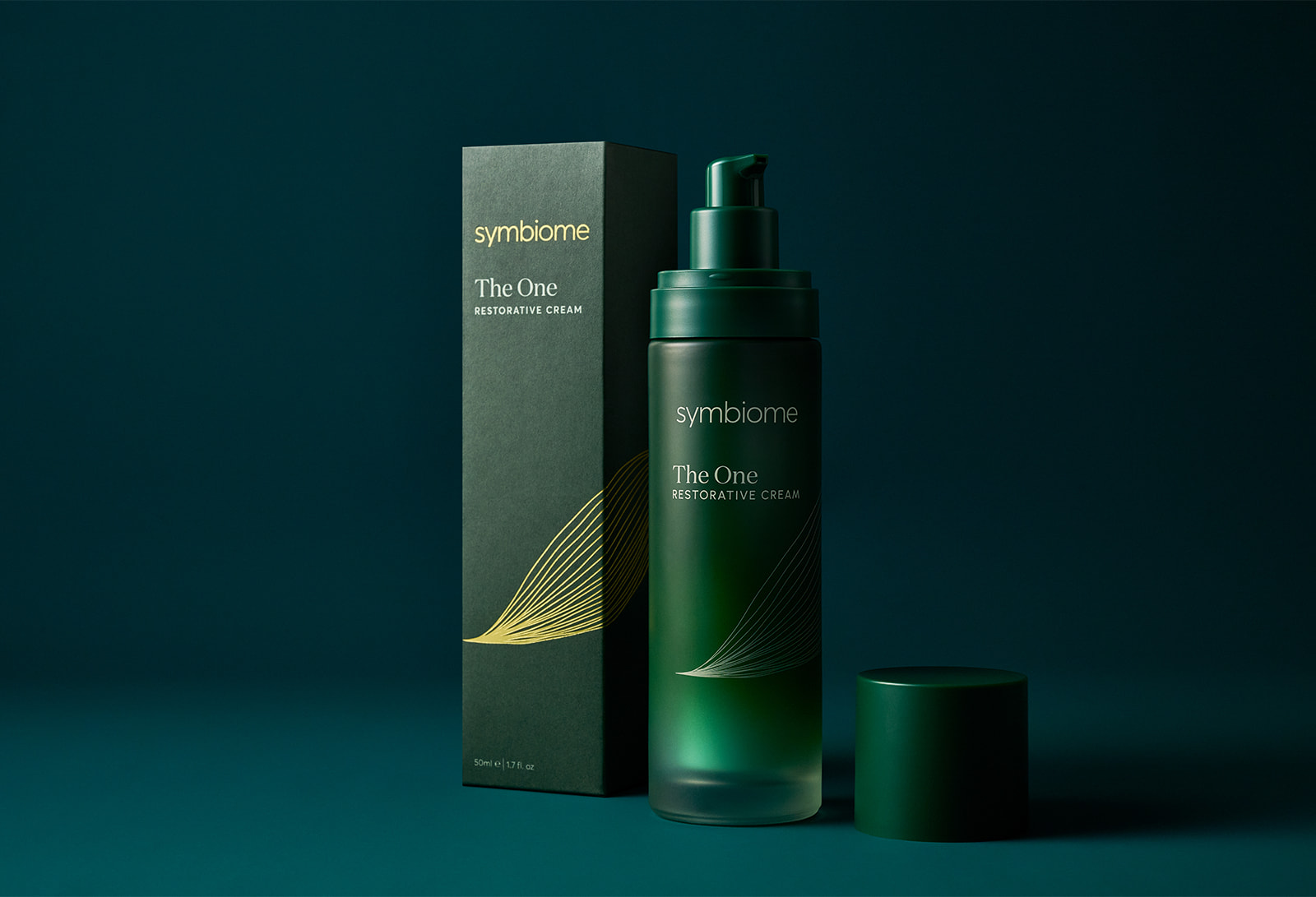
That serum, The Answer, remains the brand's top seller by a wide margin, with The One Cream ($125) holding second position. Symbiome’s core customer skews older and higher income, seeking corrective results in a simplified formula.
While the science behind Symbiome is solid, its journey as a startup skincare business has been a roller coaster of ups and downs. Symbiome launched in October 2020 completing an $8 million Series A that June with True Ventures, Bold Capital Partners, and Gisev Family Office, then added $2 million in venture debt from J.P. Morgan. Today, that model has been significantly deprioritized in favor of a more targeted, higher-touch channel: med and facial spas.
In 2025, Symbiome partnered with MeyerSPA, giving the brand access to roughly 10,000 spa doors. Today, Symbiome is carried in nearly 200 locations. At Oasis Face Bar, which operates 19 locations across Austin, Chicago, Miami, Nashville, and more, a custom six-step Symbiome facial has been added to the treatment menu.
The feedback from practitioners working closely with the line is overwhelmingly positive, according to the brand. “Symbiome has been ahead of the curve for some time now,” said Rowaida Younes, co-founder of Rowm Beauty, a premium, holistic spa and curated retail concept in Park Slope, Brooklyn.
“It's one of the first brands to implement human growth factors coupled with extensive R&D to produce unusual, highly efficacious formulations that actually work,” Younes continued. The Answer is a game changer, and the recently launched Solution for the neck and décolleté has the most discerning and well-informed clients shopping on repeat.”
According to Klausner, about 50% of the businesses that carry Symbiome are traditional facial spas, and 50% are medspas, including BioReset Medical, which operates three locations across California and Florida.
Last year, the spa channel accounted for about 10% of Symbiome's revenue. This year, Klausner expects it to reach 20%. The business did roughly $2 million in sales last year and is on track for $3 million in 2026. Year-to-date recurring revenue sits at around 53%, reflecting the brand’s stickiness.
Before pivoting to the spa channel, Symbiome almost fizzled out before it even had a chance to prove what it was capable of. Just one year after launching, Symbiome had burned through roughly $8 million in equity and $1 million in debt as a result of operational mismanagement, per Klausner. The company scaled too quickly, and operating expenses outpaced revenue by a factor of 15. Headcount grew to about 20 employees with high payroll costs, including multiple PhDs earning over $200,000 each. According to Klausner, Symbiome operated in 2020 and 2021 as if it had “an unlimited blank check,” with no consistent reconciliation between revenue and expenses. Klausner even exited the company for a brief period starting in January 2021, largely because he disagreed with how the business was being run.
In September 2021, after loan covenants were violated, J.P. Morgan foreclosed on the business and pushed it into an Assignment for the Benefit of Creditors (ABC), an out-of-court restructuring typically used for venture-backed companies with a single major creditor. The original Symbiome entity became essentially a defunct estate in ABC.
Klausner, who had originally helped close an $8 million raise in June 2020, was called back by Weiss when the foreclosure hit. What happened next is highly unusual in venture capital: the original investors stayed in. Through a diluted Simple Agreement for Future Equity (SAFE) round into a new entity, Weiss Biosciences (named for the company’s founder and Chief Scientific Officer), original investors were brought back to roughly their pro-rata positions on the cap table, and the business was relaunched by the end of the year.
“Everyone believed in the science,” Klausner recalled. “The science was super interesting and cutting edge, especially five years ago. There was a belief that this is a really scalable business, if you can figure out how to sell it.”
The category fundamentals helped make that case. Skincare margins are strong, the revenue is recurring, and the business is countercyclical. “Half the population would rather buy skincare than go out to dinner,” Klausner noted. “If you can get brand recognition and get into the right doors, it becomes a supply chain exercise.”
That the original backers are life science investors, not consumer investors, also matters. Their interest was never purely commercial.
"They're interested in impacting healthcare outcomes,” Klausner said. “And there's a belief in Larry [Weiss]. He's a very talented, very brilliant scientist and chemist. It was worth seeing this work through.”
Klausner made it clear that the Symbiome as it exists today is a different, restructured company, and is not the same as the one that launched six years ago, both legally and conceptually. After the ABC, Klausner cut a deal with J.P. Morgan to buy the assets out of the old estate, including the IP, research data, inventory, and packaging. Those assets were moved into Weiss Bioscience, which now runs the current business.
Today, key backers including Bold Capital, Gisev Family Office, and Mission Bay Capital remain on the cap table. Since the restructuring, the brand has raised approximately $6.8 million in fresh capital, bringing the total investment in both companies to $24 million. Klausner now controls the company and scrutinizes every dollar as it comes in and out. A small full-time team handles operations, with external consultants filling in on marketing and creative. Research is run through a separate 501(c)(3) entity, which makes research salaries more tax-efficient and keeps them off the operating company’s balance sheet. Klausner estimates that Symbiome’s total expense load today is about 10% of the previous iteration.
A first institutional round for the recapitalized company is targeted for Q4, earmarked for new hires, including a Chief Marketing Officer and Chief of Staff, as well as an anticipated national retail launch.
On the retail side, Symbiome recently joined Nordstrom's online marketplace and is exploring expansion into Dubai, the UK, and Europe. Internationally, the brand already ships DTC to more than 100 countries.
New products launching in summer 2026 include a mineral SPF formulated to SPF 60, containing 24% non-nano zinc oxide alongside Symbiome's fermented oils. The brand will launch the SPF in partnership with the Metropolitan Golf Association across 550 private clubs in New York, New Jersey, and Connecticut, a seemingly natural fit with Symbiome's affluent core consumer. A scalp serum is also in development for late 2026.
Despite its early hurdles, Symbiome is slowly but deliberately finding its footing. The spa channel, it turns out, was the right home all along. Spa practitioners don't need to be convinced that the microbiome matters. They're already having those conversations with clients daily, serving as a crucial bridge translating what the science says about the importance of a healthy microbiome and what it actually looks like on the skin.
For a brand that has struggled to translate complex scientific research into mass-market messaging, that environment better serves the science than most mass beauty retail shelves ever could.
“Our superpower is our products, not our ability to tell the story,” Klausner said. “Every skincare brand is selling a different flavor of vanilla ice cream. We're selling a flavor of ice cream no one's ever heard of, and trying to tell you why it matters.”
For Weiss, skincare is just one piece of the puzzle that is restoring the microbiome and improving overall health. The skin, he explained, just happens to be a biomarker that people can see improvements in relatively quickly. “If you could look in the mirror and see your coronary arteries, you'd eat differently,” he said.
“I’m in the health business. I just started with skin.”